In today's constantly evolving visual experience, our expectations for display devices are no longer just about clarity. From flat screens to curved screens, from splicing screens to irregular screens, every technological iteration is breaking visual boundaries. The emergence of LED spherical screens, combined with panoramic high-definition imaging technology, has truly achieved a visual breakthrough of "no blind spots" - no matter which angle you stand at, you can capture the same delicate and full picture. This immersive experience may be the closest visual enjoyment to "being there" at present.
Breaking down perspective barriers: spherical form+panoramic imaging, bidding farewell to visual blind spots
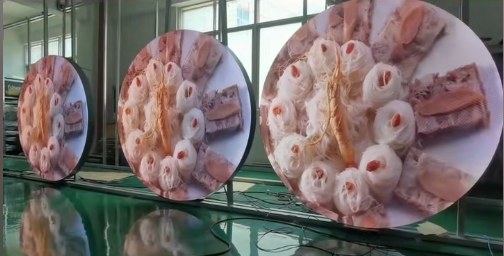
Speaking of which, the pain points of traditional display devices are actually quite obvious: flat screens have a fixed viewing angle, and deviation from the center position can result in blurry images and color distortion; Splicing screens have obvious seams that damage the integrity of the image. The spherical structure of the ledsphere itself has the inherent advantage of "360 degree no dead corners", coupled with the support of panoramic high-definition imaging technology, which is equivalent to installing a "full dimensional high-definition lens" on the spherical screen.
I once personally experienced the ledsphere at a technology exhibition. Standing in any corner of the exhibition hall, even from the side or back, the clarity and color saturation of the image did not decrease at all. Unlike traditional screens, which can feel awkward with a slight movement, LED spherical screens are like a suspended "visual core" in the air. No matter which direction you look at, you can get a complete high-definition picture. This experience without blind spots is truly eye-catching.
Panoramic high-definition imaging: not only clear, but also the ultimate presentation of details
Many people may ask, what are the advantages of LED spherical screens for high-definition imaging? The answer is simple - its high definition is "panoramic" rather than locally clear. A regular high-definition screen can only ensure the image quality in the central area, and the edges are inevitably blurred; The panoramic high-definition imaging technology of ledsphere can maintain consistent clarity of every pixel on the entire spherical surface, whether it is the details in the center of the picture or the texture at the edges, it can be accurately presented.
In fact, this is inseparable from the precise arrangement of LED beads and the optimization of imaging technology. Each LED bead undergoes precise calibration, with high uniformity in brightness and color. Then, through panoramic image processing algorithms, the image is evenly projected onto a spherical surface, avoiding the problem of local brightness and darkness. Like a carefully crafted crystal ball, every part is transparent and clear, even when zooming in on details, there will be no pixel blurring or color discontinuity.
Multi scenario adaptation: high-definition without dead corners, unlocking more application possibilities
The panoramic high-definition advantage of a spherical screen is not just for "looking good", its application scenarios are actually much wider than we imagine. In the science museum, it can simulate planetary and cosmic scenes, presenting the trajectory of celestial bodies in a 360 degree panoramic view, making the audience feel as if they are in the universe; In the mall, it can play brand advertisements in a loop, and no matter which direction customers approach, they can clearly see the advertising content, doubling the promotional effect directly.
Even at large-scale event venues, LED spherical screens can play a significant role. For example, concerts and press conferences can serve as the core visual carrier, presenting panoramic stage images and special effects, allowing live audiences to have the same visual experience no matter where they sit, without having to regret being "seated off center and unable to see clearly". Perhaps in the future, with the upgrading of technology, LED spherical screens will enter more daily scenes, making high-definition vision without blind spots the norm.
Experience upgrade: not just display, but also a new carrier of immersive interaction
I have always believed that a good display device should not only be "able to see", but also "have a sense of immersion". The panoramic high-definition display of the ledsphere precisely achieves this. It does not have a fixed "viewing direction", so there is no need to deliberately search for the best perspective. As long as you are around it, you can naturally blend into the picture. For example, in a planetarium, when the ledsphere presents a panoramic view of the starry sky, you will feel as if you are standing under the starry sky, with each star clear and touchable. This immersive experience cannot be replaced by traditional screens.
Moreover, the high-definition display of LED spherical screens can be combined with interactive technology to achieve a richer experience. For example, touch sensing and motion capture allow viewers to interact with the spherical screen through gestures and actions, manipulate screen switching, and zoom in on details, making the visual experience no longer "one-way viewing", but "two-way interaction". The characteristic of balancing high definition, no dead corners, and interactivity has truly unlocked new possibilities for visual experience in LED spherical screens.
Ultimately, the panoramic high-definition display of LED spherical screens is not simply a "technical overlay", but a redefinition of visual experience. It breaks the perspective limitations of traditional screens and extends high-definition image quality to every corner, turning "no dead corners" from a slogan into a reality. Whether it is technology display, commercial promotion, or cultural entertainment, it can bring a brand new visual impact to people with its unique advantages. I believe that in the near future, this seamless high-definition visual experience will enter more people's lives and become the new mainstream of visual display.