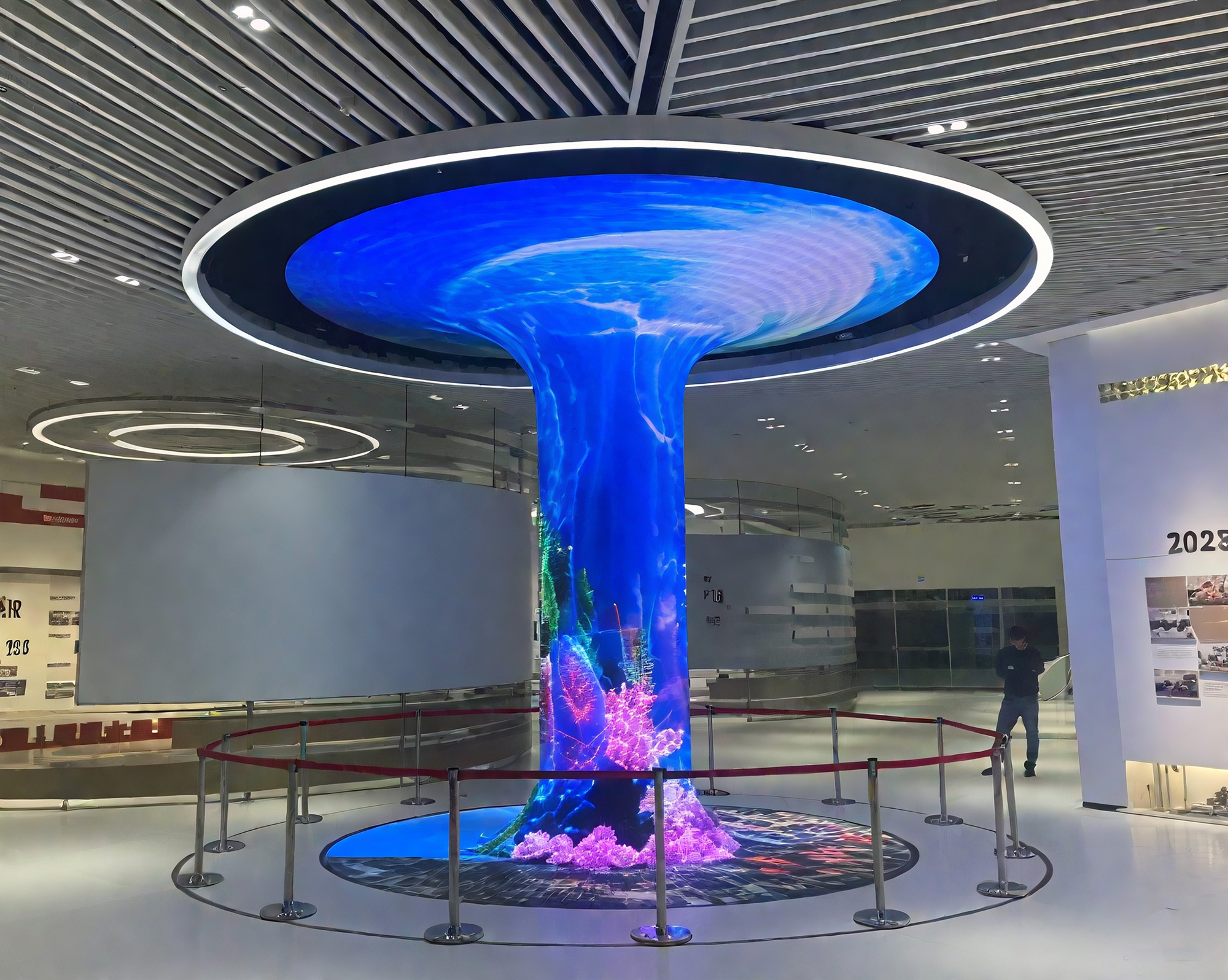
In 2026, the buying question is no longer “who sells the cheapest LED ball screen.” It is “which manufacturer controls the three variables that decide whether a sphere looks premium or falls apart in 18 months”: Mini/Micro-LED chip sourcing, COB vs SMD packaging, and modular curvature engineering.

Why 2026 Is the Inflection Year for Spherical LED
Demand democratized. From 54-meter municipal domes in China to 30–85 cm retail spheres in malls and auto showrooms, the diameter range widened. Small indoor “mini sphere” units (30–60 cm, P1.2–P1.8 COB) now ship at 4,950 depending on pitch, down from custom-only pricing.
Supply chain consolidated in Shenzhen. Chinese manufacturers hold ~70% of global sphere-screen output; Shenzhen alone clusters beads, driver ICs, sheet-metal frames, and calibration software. Fewer than 20 of 500+ suppliers run self-developed curved-splicing algorithms.
Packaging shifted. COB penetration in fine-pitch LED crossed ~65% in upstream packaging; sub-1mm pitches are effectively COB/MIP territory, while SMD survives in P2.0+ outdoor and rental spheres.
Mini-LED, COB, SMD: What Actually Matters on a Sphere
Variable | SMD (traditional) | Mini-LED (SMD-based fine pitch) | COB / Flip-COB |
|---|---|---|---|
Sweet pitch | P2.0–P10 | P1.2–P1.8 | P0.4–P1.5 |
Surface | Exposed lamps | Exposed small lamps | Resin-sealed face |
Impact / IP | Low (needs extra housing) | Moderate | High (IP54 bare, IP65 potted) |
Close-view (<2.5 m) | Visible pixel grain | Better, still grainy | Smooth face-source, no glare |
Repair | Single-lamp swap | Single-lamp swap | Module swap / factory |
Premium vs SMD | Baseline | +10–20% | +15–30% |
Best sphere use | Outdoor big domes, event rental | Mid-size indoor brand spheres | Luxury retail, museums, control-room grade |
Diameter >4 m, viewing >5 m, outdoor → SMD P4–P8, weatherproof cabinet.
Diameter 1–3 m, indoor, 2–4 m view → Mini-LED SMD P1.5–P2.5 for cost balance.
Diameter <1.5 m, touch distance <2 m, museum/luxury → COB P0.9–P1.5, accept the premium.
Modular Design Is the Real Moat
Latitudinal module zoning — module arc width changes by latitude, not one wedge fits all.
Pre-calibrated curved batches — pixel-by-pixel brightness/color calibration before shipping; automated algo adoption is still <30% industry-wide, so ask who calibrated and with what tool.
Tool-free mechanical lock — ISLE 2026 trend: minimalist cabling, larger module sizes, foldable/plug-and-play structures for non-landmark installs.
Thermal continuity — COB spreads heat through resin; SMD creates hot spots at poles where airflow dies. Sphere cooling is a structural problem, not a fan problem.
Manufacturer Tiers Buyers Actually Encounter
Unilumin— scale, global service, large-format sphere + XR content integration.
Leyard — sub-1mm fine pitch, control-room grade.
Absen — energy-optimized indoor spheres, strong overseas compliance paperwork.
Leyman — COB-centric, P1.2–P2.0 museum/boardroom spheres.
DOIT VISION — P0.7 triangular sphere modules, Dubai-scale installs, ~22% global sphere share per one 2025 estimate.
SACO Technologies (North America, sports/landmark), Daktronics (US stadiums), Samsung/LG (Micro-LED premium, KR).
Threerise, Maxcolor, Toosen, HSC LED — volume SMD ball screens, 0.5–2 m diameter, Alibaba-export oriented.
Sourcing Checklist: 7 Things to Verify Before PO
Calibration certificate — per-module or whole-sphere? Automated or manual? (Manual pole calibration = 15–20 days, error-prone.)
Pitch + diameter + viewing distance math — P1.5 at 60 cm diameter is overkill; P4 at 6 m indoor is blurry.
COB resin flatness sample — request a 30× macro photo of the lit surface.
Curvature tolerance — wedge angle variance across latitudes (±0.5° max for seamless).
Content pipeline — 90% of buyers hand over flat MP4s; sphere needs equirectangular or 3D-engine output. Ask if the factory bundles content partners.
Certs for target market — CE/FCC/EMC/RoHS; Middle East and EU increasingly reject uncertified creative LED.
Spare module policy — COB means you need matched-batch spares from the same calibration run, not random replacements.
Supply-Chain Risk Notes for 2026
Driver IC + fine-pitch beads still partially import-dependent (US/EU trade friction affects BOM ±8–12%).
Content cost is the hidden budget line: custom 360° content runs 5–8× flat video, can eat 20%+ of small-project budget.
After-sales distance — Middle East/SEA demand is hot, but local technical staff is thin; pick factories with overseas warehouse or partner SLA.