From monochrome slogan screens lining the streets and alleys to immersive visual effects carriers on the Spring Festival Gala stage, leddisplay have long surpassed their role as mere display tools and become a core medium that connects technology and life, carrying information and aesthetics. This invention, originating from semiconductor technology, has undergone decades of iterations and is now embarking on a new era of development with "intelligence" and "green" as its dual wings.
The advancement of leddisplay began with a race between pixels and technology. The birth of red LEDs in 1962 marked the beginning of commercial use, while the breakthrough of blue LEDs in 1993 ushered in the era of full-color displays. Nowadays, technological competition has evolved from a mere competition in dot pitch to an ecosystem competition: Mini/Micro LEDs, with their color gamut coverage exceeding 97%, have entered professional fields such as film and healthcare; COB packaging technology, with its high reliability and seamless display effect, has become the growth engine of the mainstream market, with an expected year-on-year output value increase of 25% by 2025. From pin-type packaging to SMD technology, from passive display to intelligent interaction, every technological breakthrough broadens the boundaries of application.
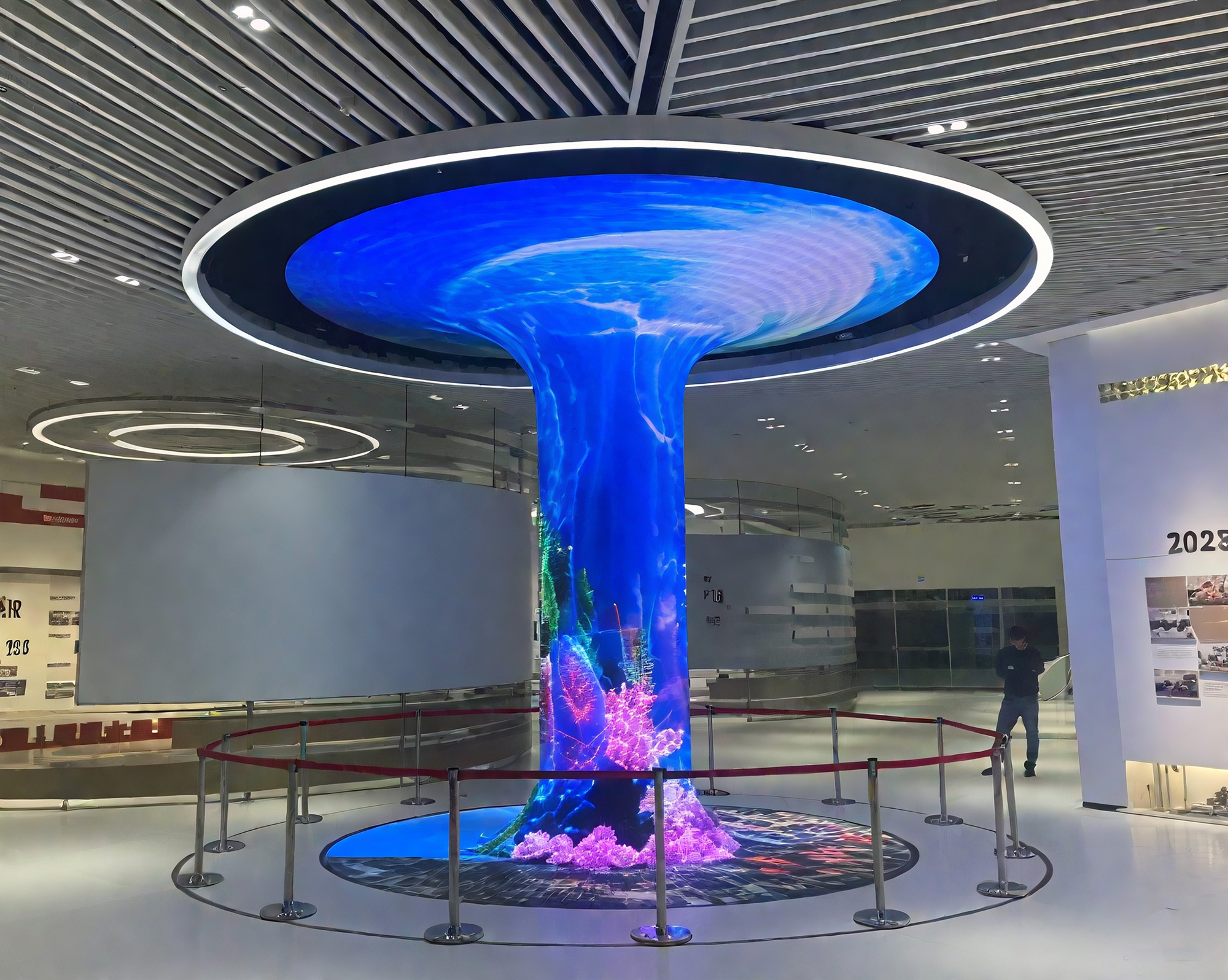
In daily life, leddisplay have become ubiquitous. In commercial districts, giant screens create immersive marketing with high-definition dynamic images; in transportation hubs, they provide real-time flight information and traffic guidance, becoming a standard for travel; in sports venues and concert sites, the vibrant screens synchronize with the moments of the event, enhance the atmosphere, and reconstruct the audio-visual experience. What deserves more attention is the transformation brought by AI empowerment: smart screens can analyze crowd density in real time and recommend evacuation routes, optimize content adaptation and fault warnings through algorithms, and upgrade from passive display terminals to active interactive nodes.
Green sustainability has become the core competitiveness of LED technology. Facing the "dual carbon" goals, the full-chain energy-saving design significantly enhances the energy efficiency ratio. The AI brightness adjustment system can adapt to brightness in milliseconds based on ambient light, and combined with dynamic energy-saving technology in dark field areas, it can reduce power consumption by 20%-35%. This not only reduces electricity costs but also avoids light pollution. This "breathing light" allows technology and environmental protection to coexist.
From the dim light of the laboratory to the matrix of urban lights and shadows, the evolutionary history of leddisplay serves as a vivid footnote to how technology serves life. When screens can think and light adapts, they become not only information windows but also a bridge for dialogue between people and cities, technology and scenes. In the future, with continuous technological iteration, leddisplay will surely shine even brighter in the blueprint of smart life.